Contents
All 7 parts
- 1Malawi Knows What It Needs. The Gap Is in Delivering It.
- 2Malawi Has Led Before
- 3The Hidden Brake: Dollars, Inflation and Debt
- 4Trained and Waiting
- 5Energy, Water, Rail, the Lake and Links with NeighboursExpected Saturday 14 November
- 6Farming Beyond Maize, Minerals, Tourism, ExportsExpected Saturday 21 November
- 7Technology, Diaspora, Diplomacy, the Aviation HubExpected Saturday 28 November
In its 2026/27 budget, the Government of Malawi set aside about K2.8 trillion to pay interest on its debt. Education and health together get about K2.3 trillion. Interest exceeds the two by half a trillion kwacha. The World Bank calls it “the single largest expenditure line in the national budget”.
Twenty years ago, it was not like this. In 2006, after years of campaigning by debtor countries and churches, the rich world wrote off most of what Malawi owed. The Ministry of Finance’s own figures show public debt falling from 130% of national income in 2005 to 30% in 2006. Malawi had a chance to begin again. By December 2025, debt was back to 93% of national income, and the International Monetary Fund (IMF), the global lender countries turn to in a currency crisis, rated it “in distress”.
What the Shortage Looks Like
Malawi’s problem begins with dollars. The country sells the world about US$1 billion a year in goods, a figure the World Bank describes as “essentially flat” since 2010. Its shopping list has kept growing. Imports rose from US$2.2 billion to US$3.7 billion over the same period, so Malawi now buys close to four dollars of goods for every dollar it earns. Aid, money sent home from abroad and borrowing help fill the gap, which reached about US$2.7 billion in 2025. Whatever remains unfilled becomes a shortage.
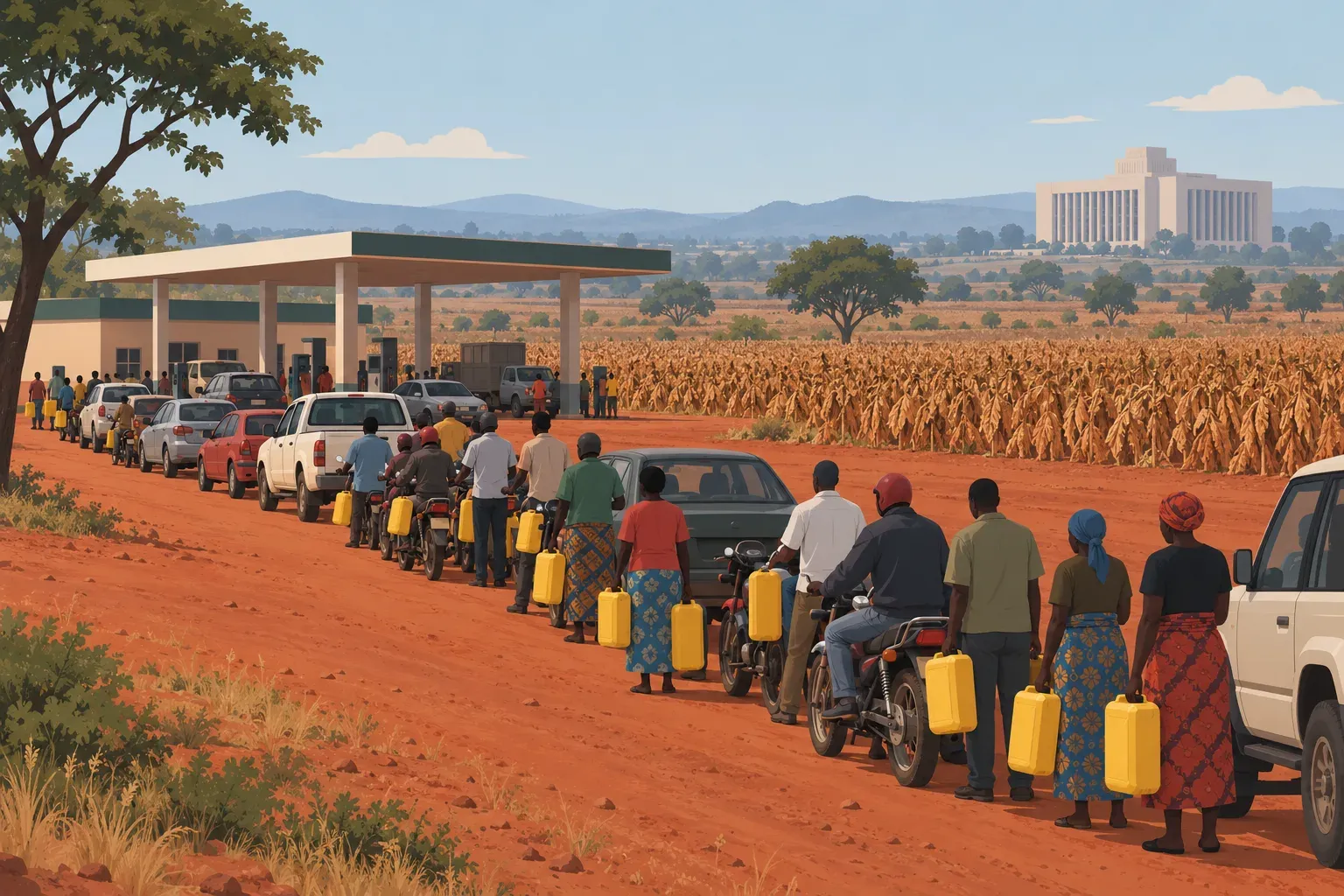
Most Malawians know what that shortage looks like. Fuel accounts for about a fifth of the monthly import bill, and fertiliser is another major expense. When dollars run short, queues form at the pump and the planting season waits. In April 2026, pump prices rose by 108%.
The two prices for a dollar tell the rest. The official rate, set by the Reserve Bank of Malawi, has stood at about K1,750 since early 2024. On the street, in the parallel market, a dollar cost about 130% more in June 2026. The Reserve Bank’s gross official reserves, the dollars it holds to pay for imports and defend the currency, stood at US$149 million at the end of 2024. That was enough for about twelve days of imports. The usual safe minimum is three months.
The Loop
Why does a country with such a wide trade gap keep its official exchange rate fixed? A cheap official dollar makes fuel, fertiliser and medicine cheaper for whoever can get it. Devaluation makes everything dearer at once. Those concerns are real. But the overvalued official rate, in the IMF’s words, “acts as a tax on exporters and subsidizes imports”, while “incentivizing foreign exchange to leave the system”.
Tobacco shows how. It earns about 40% of Malawi’s export revenue, and it is sold at the official rate. A farmer or exporter who receives K1,750 for a dollar worth K4,000 on the street has every reason to grow less, sell elsewhere or keep the dollars out of the system. Importers, meanwhile, have every reason to overstate what they bring in so they can claim more cheap dollars. The IMF found signs of over-invoicing of 20% to 40% on imports. The fixed rate, meant to protect the country from the dollar shortage, deepens it.
Eventually, the rate breaks. Malawi has had at least four such breaks. In February 1994, the kwacha was floated, falling from about K4.5 to over K17 to the dollar by September; inflation reached 98% in July 1995. In May 2012, the kwacha was devalued by nearly half; inflation rose from 12% before the move to 38% in February 2013. In May 2022, it was devalued by 25%, and in November 2023 by 44%. Inflation reached 35% in January 2024 and stayed above 30% until November.
Each devaluation was supposed to close the gap between the two prices for the dollar. Each time, after the pain had been taken, the rate was fixed again. The World Bank’s review, published in September 2026, puts it plainly: “following each devaluation, the authorities effectively re-fixed the official rate, recreating the very conditions that had triggered the crisis in the first place”.
After the 44% devaluation in 2023, the kwacha was held at about K1,750 from early 2024 onward while prices kept rising. By mid-2025, the IMF estimated, it had appreciated by more than 26% in real terms since the devaluation, “substantially erasing the benefits”. The gap between the two rates was back above 150% by early 2025. The public had paid the price in inflation. The benefit had been thrown away.
How the Debt Came Back
The dollar loop explains the shortages. The debt has its roots in the budget, and the turning point can be dated.
In 2013, officials discovered that money was being stolen through the government’s own payment system. The theft became known as Cashgate. Donors, who were then funding a large share of the budget, stopped their support. The IMF put the immediate loss at “about US$180 million” in a single quarter, more than half of the year’s budget support and related grants. Budget support fell from over 6% of national income in 2012/13 to what the IMF expected would be “only half a percentage point” two years later. It has not returned.
The state did not shrink to fit. It kept spending and borrowed at home to cover the gap. The IMF described the result in 2015: “donor budget support remained suspended, resulting in increased recourse to domestic financing, monetization of the deficit, and the emergence of domestic payment arrears”.
Ten years later, the description was much the same. Malawi “does not have access to international capital markets”, the IMF wrote in 2025, and “to finance fiscal deficits, Malawi has come to increasingly rely on the more costly domestic debt market”. The Ministry of Finance says the rise in debt “was driven primarily by domestic borrowing, reflecting ongoing fiscal financing requirements and constrained access to concessional external financing”. “Fiscal financing requirements” means the gap between what the state collects and what it spends.
Foreign borrowing is now constrained by rules as well as trust. As a condition of World Bank grants, Malawi has agreed to a “zero non-concessional debt ceiling”: no new commercial foreign loans at all. New cheap loans are tied to an IMF programme, and Malawi’s record with those programmes is poor.
The government cancelled the 2018 programme in 2020. The IMF later found that it had rested on misreported reserves: the Reserve Bank had counted pledged deposits and short-term swaps as dollars it held. The 2023 programme, approved alongside the 44% devaluation, “automatically terminated on May 14, 2025 after eighteen months since approval without completing a review”. Two programmes since 2018. Neither finished.
Domestic borrowing became the default. Of the K24.3 trillion Malawi owed at the end of 2025, K16 trillion was owed at home, most of it in Treasury notes paying yields of around 30% and more in 2025.
Compare that with the loans Malawi can no longer get enough of. A standard World Bank credit runs for about 30 to 40 years, with six years before the first repayment, no interest and a service charge of about 1% a year. A Treasury note costs twenty to thirty times that and falls due in two to ten years. Malawi swapped the cheapest debt in the world for some of the dearest. Its 2026/27 budget plans to finance 93% of the new deficit through domestic borrowing.
Nearly half of those Treasury notes are now held by the Reserve Bank itself. Its holdings rose from K3.8 trillion in March 2025 to K6.1 trillion in December 2025, “approximately 46.8 percent” of all Treasury notes held in the country. A central bank that buys its government’s debt creates kwacha with nothing new to spend them on. The IMF calls this “fiscal dominance”: the budget runs monetary policy.
The IMF’s board called for fiscal adjustment “to eliminate deficit monetization”. Its safeguards review told the Reserve Bank to stop using its purchase window “as a liquidity management or government financing tool”. Three years after the last devaluation, inflation was still 19.4% in September 2026, the first month below 20% since 2022. The Bank was already holding about 60% of domestic debt in 2013. The habit is older than the current crisis.
Who checks this borrowing? On paper, Parliament approves every loan. In practice, a 2024 study by Princeton’s Sovereign Finance Lab, citing the Open Government Partnership, found that loan bills “can appear on the agenda without adequate notice to members of parliament; without disclosure of loan details; and without involvement of the parliamentary Budget and Finance committee”. Parliament was left with a “rubber-stamping” role, while the executive retained “considerable (and unchecked) control over borrowing decisions”. The one hard limit on central bank lending to the government in recent years, a cap written into the Reserve Bank Act in 2015, came out of an IMF programme.
The dollar borrowing is smaller but harder to repay. Since 2012, the Reserve Bank has taken short-term commercial loans from two regional banks, the African Export-Import Bank and the Trade and Development Bank, to finance fuel and other imports. At the end of 2025, it owed them about US$1.1 billion. These loans carry commercial interest and short repayment deadlines. By the end of 2024, Malawi was US$669 million in arrears on them.
Restructuring talks began in 2022. The process, in the World Bank’s words, “remains unresolved amid protracted negotiations”. One of the two lenders has said it is not taking part in restructuring talks with any of its member countries.
What It Costs
The 2026/27 budget makes the cost plain: K2.8 trillion for interest, against about K2.3 trillion for education and health together. Even the entire human development group of the budget, which includes those two sectors and more, receives less than interest: K2.7 trillion.
In the year just ended, interest took nearly half of what the state collected in taxes and fees. In its April 2023 regional review, the IMF singled out three countries in sub-Saharan Africa for the share of 2022 revenue consumed by interest: Ghana, Malawi and Zambia, at roughly 45%, 37% and 31%, against a regional median of 11%. Ghana and Zambia defaulted and restructured. Malawi’s share has since risen to nearly half.
Add wages and pensions, and statutory bills absorbed about 93% of domestic revenue over the past four years, and nearly all of it in 2025/26. What remains for roads, clinics, irrigation and everything else is what the state can borrow.
The United Nations Children’s Fund (UNICEF) tracks the shift. Between 2021/22 and 2024/25, the share of the budget going to debt charges rose from 14.5% to 24.3%, while education’s share fell from 16.5% to 14.7%. When cuts come, the World Bank notes, they “have largely affected capital spending”, the building of things, because wages and interest cannot be cut. The dam that is never built, the irrigation scheme that stalls at the design stage, the clinic without a working machine: these are often what a debt-service bill looks like on the ground.
Who Got Out, and What It Took
Malawi is not the only country to have been here. Ghana defaulted on its debt in December 2022. Zambia defaulted in November 2020. Ethiopia ran out of dollars and kept a managed exchange rate with a wide parallel premium until 2024. All three now look different.
After a three-year IMF programme, Ghana had inflation of 5.3% in June 2026, reserves worth four months of imports and a budget surplus before interest. Zambia, five years after its default, had inflation back inside its target band, reserves worth 4.4 months of imports and restructuring deals covering 94% of the debt it set out to restructure. Ethiopia floated its currency in July 2024 with an IMF programme behind it. The parallel premium, once as wide as Malawi’s, fell to between 10% and 20%, and reserves tripled.
The three followed the same broad path. They let the exchange rate move and kept it moving. They cut the deficit enough to stop borrowing from their central banks. They finished, or nearly finished, restructuring their old debts under IMF programmes that anchored the other steps and unlocked other lenders.
In every case, the cost came first. Inflation worsened before it improved, for a year or more, and the people who bore it were those who could least afford to.
Egypt is the warning. It floated the pound in 2016 and was praised for it. Within a few years, the rate was being managed again, a parallel market reopened, and inflation reached a record 38% in September 2023. It took a second float in 2024, backed by large outside investment, to close the gap again. A float that is later undone leaves the cost of devaluation without the lasting benefit. Malawi’s record follows the same pattern.
The Half That Was Missing
Malawi’s 2023 devaluation was its latest reset. It came with an IMF programme, the first in years, but the programme lapsed in May 2025 without completing a single review. A new one is being negotiated. In October 2026, the IMF said reforms so far “provide a good foundation” for a programme, but no agreement had been announced. The government has said devaluation is not under discussion; other reports expect one anyway.
The record shows what breaking the loop requires. The IMF, which has urged Malawi for years to unify its two exchange rates, adds a caution in the same report: a realignment “in the current context of macroeconomic instability and lack of policy credibility, especially fiscal, is likely to perpetuate the depreciation-inflation cycle”. That is the lesson of 2012 and 2023 in one sentence. Without a budget that stops the central bank from financing the deficit, devaluation buys another year of inflation and no lasting gain.
Malawi has taken the painful half of this medicine repeatedly. The public has paid each time through the price of maize and fuel. The country has never sustained the other half: a budget that stops borrowing from the central bank. The Ministry of Finance’s own statement identifies domestic borrowing as the main driver of the debt. Restraining that borrowing is also the half entirely within Malawi’s control. No donor, creditor or exchange rate can do it for the government.
In 2006, Malawi’s debt was written off and the country began again at 30% of national income. Twenty years later, it is above 90%, and interest costs more than education and health combined. No creditor did that. The budget did.
None of this is hidden. The Ministry of Finance, the Reserve Bank and the IMF have each written it down, year after year, in documents that are public and mostly unread. The dollars, the inflation and the debt are the brake on everything else the country tries to build. That brake was set at home. It will be released at home or not at all.
Sources and further reading
- Ministry of Finance, Economic Planning and Decentralisation, 2026/27 Approved Financial Statement (Budget Document No. 3), 2026
- World Bank, Malawi Economic Monitor 23: Building Stability to Unlock Growth, September 2026
- International Monetary Fund, Malawi: 2025 Article IV Consultation, Country Report 25/226, August 2025
- International Monetary Fund, Malawi: Third and Fourth Reviews Under the Extended Credit Facility, Country Report 14/37, February 2014
- International Monetary Fund, Malawi: Fifth and Sixth Reviews Under the Extended Credit Facility, Country Report 15/83, March 2015
- International Monetary Fund, Press Release 22/389, Executive Board reviews Malawi misreporting, 17 November 2022
- International Monetary Fund, Press Release 25/261, Executive Board concludes 2025 Article IV consultation with Malawi, 22 July 2025
- International Monetary Fund, Regional Economic Outlook: Sub-Saharan Africa, The Big Funding Squeeze, April 2023 (Figure 2)
- MyJoyOnline, “Ghana spent 45% of revenue on interest payments in 2022, IMF”, 17 April 2023
- World Bank Treasury, IDA Lending Rates and Fees, effective 1 October 2026
- Princeton Sovereign Finance Lab, Policy Brief 24-3: Malawi, 2024
- The Nation, “Treasury explains IMF ECF cancellation”, 15 September 2020
- Reuters via CNBC Africa, “IMF says Malawi visit makes progress towards new lending programme”, 7 October 2026
- Reuters via Investing.com, “Egypt’s inflation quickens to record 38.0% in September”, October 2023
- International Monetary Fund, Press Release 06/187, Malawi reaches HIPC completion point, 1 September 2006
- Simwaka, K., The Behaviour of the Malawi Kwacha in a Liberalized Environment, Reserve Bank of Malawi, 2005
- Simwaka, K., Modelling and forecasting the Malawi kwacha-US dollar nominal exchange rate, MPRA Paper 3327, 2007
- National Statistical Office, Consumer Price Index, September 2026
- National Statistical Office, January 2025 Consumer Price Index (Table 1, January 2024 = 35.0%)
- National Statistical Office, October 2024 Consumer Price Index
- National Statistical Office, November 2024 Consumer Price Index
- UNICEF Malawi, 2024/25 Education Budget Brief
- The Nation, “Afreximbank says not in debt talks with Malawi”, 12 June 2025
- The Nation, “Govt raises K249.8bn in Treasury notes auction”, 2 April 2025
- The Nation, “Statutory costs choke revenue”, 28 November 2025
- The Nation, “Unit sees renewed IMF push for devaluation”, 9 July 2026
- Nyasa Times via allAfrica, “Malawi Govt Says Kwacha Devaluation Not Part of IMF Negotiations”, 9 October 2026
- Ministry of Finance, Ghana, Suspension of Payments on Selected External Debts, 19 December 2022
- Parliament of Zambia, Ministerial statement on the Eurobond default, November 2020
- Gulf News, “IMF says Egyptian pound at genuine equilibrium after float”, 2018
- Ahram Online, “US dollar rate hits all-time high in parallel market”, 2023
- International Monetary Fund, Ghana: sixth and final ECF review, 27 July 2026
- International Monetary Fund, Zambia: staff concludes visit, 14 May 2026
- International Monetary Fund, Ethiopia: Fifth Review under the ECF, Country Report 26/174, June 2026
- International Monetary Fund, Egypt: staff-level agreement, 6 March 2024