Contents
All 7 parts
- 1Malawi Knows What It Needs. The Gap Is in Delivering It.
- 2Malawi Has Led Before
- 3The Hidden Brake: Dollars, Inflation and Debt
- 4Trained and Waiting
- 5Energy, Water, Rail, the Lake and Links with NeighboursExpected Saturday 14 November
- 6Farming Beyond Maize, Minerals, Tourism, ExportsExpected Saturday 21 November
- 7Technology, Diaspora, Diplomacy, the Aviation HubExpected Saturday 28 November
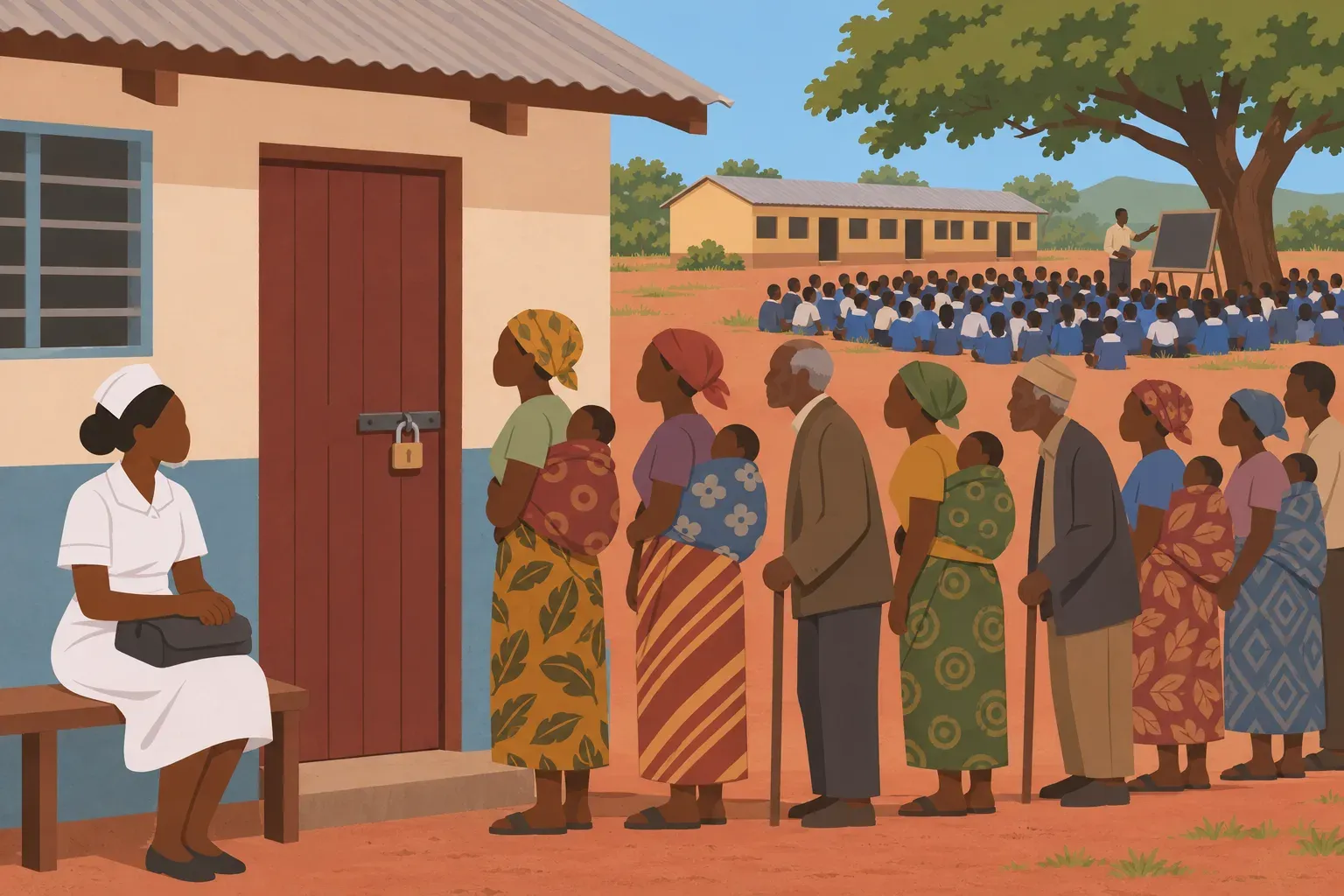
In November 2019, a Malawian newspaper told the story of a nurse who had qualified the year before at the Malawi College of Health Sciences. After a seven-month internship at a district hospital, she went home to live with her parents. When a hospital needed cover, she worked a full month as a relief nurse, day and night, alone on a ward. She was paid K52,000. “Imagine,” she said, “nursing the whole ward by yourself day and night and receiving K52,000 in turn.”
She was one of 3,012 licensed nurses and midwives whom the jobless nurses’ own association counted as unemployed that year. The number has barely moved since. Government statistics put it at about 3,000 in 2023. The nurses’ professional body said about 3,000 in May 2025.
At the same time the clinics were short of nurses. In 2021, by the Ministry of Health’s own count, 51% of front-line health posts in public and mission facilities stood empty. Put against the population, Malawi had fewer than three health workers for every 1,000 people in 2020. The World Health Organization’s benchmark is 4.45. A country of about 21.7 million people in 2024 was running its health service with about two-thirds of the staff that standard calls for, while 3,000 trained nurses sat at home.
Malawi has the plan: the Ministry of Health’s own strategy names the empty posts as its first problem. It has the people: the colleges have trained them and they are at home. It even has the money lines: in 2024/25 the Ministry of Health left K137 billion of its development budget unspent, by the Auditor General’s count. What it has not done is the last step, which is to hire. That is the implementation gap at its simplest, one signature short of a nurse on a ward, and in health it is now measured in newborn deaths. And the donors who covered that gap for twenty years are leaving.
What Was Won, and Where It Stopped
Malawi’s record before this gap is a good one. In 1992, 234 of every 1,000 children born in the country died before their fifth birthday. In 2024, the figure was 48. When primary school fees were abolished in 1994, enrolment jumped from 1.7 million to 2.6 million in a single year. Administrations of every stripe since then can claim a share of those gains.
Since about 2015, the gains for the youngest children have stopped. The 2024 Demographic and Health Survey, the national household survey run by the National Statistical Office, splits the fifteen years before it into three five-year periods. Deaths of newborns in their first month were 22, then 23, then 24 for every 1,000 births. No improvement in fifteen years. Stunting, the share of children too short for their age because of poor nutrition, “declined from 55% in 1992 to 37% in 2015–16 and remained at a similar level (38%) in 2024”, in the survey’s own words.
In the schools, the children who came in did not learn as much as the enrolment numbers promised. The 2019/20 Multiple Indicator Cluster Survey, run by the National Statistical Office with the United Nations Children’s Fund (UNICEF), found that 19% of children aged 7 to 14 could read a short story at Standard 2 or 3 level and answer questions about it.
Both of these come down to people. Whether a newborn lives through her first month depends a great deal on who is in the room when she is born, and whether that person was trained for it. Whether a child learns to read depends on who stands at the front of the class, and on how many other children are in it. Malawi has trained the nurses and the teachers. What follows is the story of why so many of them are not in the room.
The Nurses
The Ministry of Health’s own plan, the Health Sector Strategic Plan III for 2023 to 2030, does not say the problem is a shortage of graduates. By the plan’s own figure, training colleges turn out about 3,000 health workers a year. The first bottleneck the plan names is “high vacancy rates with poor absorption”, which “is partly due to challenges with aligning inter-ministerial and intersectoral partners on increasing financing of remuneration and benefits”. In plain words: the money for salaries has not been agreed.
The plan says “it is poor value-for-money to not absorb trainees” the state has already paid to train. It puts the cost of hiring every front-line graduate of the 2024/25 class at US$5.4 million.
The decision does not sit with the Ministry of Health. Posts have to be on a funded list held by the civil service’s human resources department. Asked in April 2025 what had been budgeted for new recruits’ salaries, the Ministry’s spokesperson told The Nation “there is no separate budget for this”. The Ministry asks for positions and waits.
When hiring does happen, someone else usually pays. Of the 5,992 health workers recruited in 2025, 4,250 were funded by the Global Fund, the international body that finances the fight against AIDS, tuberculosis and malaria. The government’s own walk-in recruitment that April ended up in the High Court. In July 2025 the court stayed the hiring of candidates for three nursing posts, in a case brought by 500 nurses and midwives, after the Nurses and Midwives Council found that some recruits were not yet registered or licensed. In 2026, the government agreed to send 500 nurses to Israel to work.
The Cliff
For two decades, donors have paid for much of the staff the state would not put on its own payroll. In 2023 they paid 66% of Malawi’s health spending. That is ending, and fast. On 13 January 2026, Malawi signed a five-year health agreement with the United States. The text, published by a Washington watchdog, sets out American support falling from US$179.4 million in 2026 to US$107.1 million in 2030. In return, Malawi must raise its own health spending by US$143.8 million a year above its 2025 level by 2030. If it falls short, “the U.S. Government plans to decrease its funding by ratio of one (1) to one (1)”.
The government’s own health spending in 2023 was about US$5 a person, roughly US$110 million a year in all. Set against that, the agreement means more than doubling its own health spending in four years. The United Kingdom is cutting its aid to Malawi from £50 million in 2025/26 to £5 million by 2028/29. By July 2025, UNICEF reported, American health funding to Malawi had already fallen by 66%.
Malawi therefore has about four years to do in health what it has not done in ten: pay for its own nurses. The question of who hires them now sits where it always belonged, with the government in Lilongwe, and the clock on it is American and British.
The Teachers
Can a state that has not hired for ten years hire in four? Its teachers say yes. For most of the same decade they faced the same wait, and in 2025 it ended in weeks.
KfW, Germany’s state development bank, whose initials stand for Kreditanstalt für Wiederaufbau, paid to upgrade teaching-practice schools and three teacher training colleges in Malawi, and sent evaluators in 2025 to see what had come of it. Their report is blunt. In 2018/19, 8,434 teachers were given permanent posts. In 2023/24, “only 2,500 permanent and 4,200 temporary new hires took place”. Three whole graduating cohorts had “not yet been recruited”. Graduates “may have to wait several years before finding employment”. The government had cut college intakes in response, leaving the colleges at about 30% of capacity.
The Ministry of Education had already said as much. In July 2023, its Principal Secretary told The Nation: “We are not recruiting all the teachers that we have trained because of resources.”
The children sat in crowds. In 2023/24, there were 65 pupils for every qualified primary teacher in Malawi. At Ntawa Full Primary School in Thyolo, which has nearly 1,600 pupils and 24 teachers, the head teacher says the ratio has improved from one teacher for every 125 pupils to one for every 75. A single auxiliary teacher arrived in September 2025. “We received nearly 20 applications,” the head teacher told The Nation in April 2026, “but only one teacher was selected.”
Then, in 2025, the state showed what it could do when it decided to. At the end of May, a circular from the Ministry of Local Government announced that 26,284 serving teachers had been promoted by one grade, opening the entry grade beneath them. On 28 July, the Local Government Service Commission held interviews across the country. By 1 September, under a presidential directive, about 20,500 primary teachers had been recruited and were reporting for duty, more than twice the 8,434 hired in 2018/19.
This happened in the months before the 2025 election. Seven weeks after the vote, the new administration froze civil-service recruitment, with exceptions only for what it called essential and critical sectors.
What changed for the teachers was that someone decided to hire them, and the system did the rest in a matter of weeks. Nobody has yet made that decision for the nurses.
The Money
The money is tight. The public wage bill grew from K480 billion in 2021/22 to a projected K1.6 trillion in 2025/26, about 38% of the taxes the state collects at home. In the 2026/27 budget, interest on debt takes K2.8 trillion. The International Monetary Fund (IMF), the global lender countries turn to in a currency crisis, told Malawi in July 2025 that “it will be essential to contain the interest and wage bills”.
Yet the same state does not spend what it has. The Auditor General’s report for 2024/25 shows that the Ministry of Health spent 59% of its budget. It left about K137 billion of its development vote unspent, the largest amount among the ministries the auditors listed. Its accounts received an adverse opinion, the worst available, for the second year running. The Ministry of Education, in the same year, overspent its running costs while about K57 billion of its building money went unspent.
The plans assume money that does not exist. The health plan costs everything it wants to do at US$31.2 billion over eight years, then says it “will realistically be implemented at $4.7 billion”.
The government’s own share has shrunk as the donors’ grew. In 2000, it paid 43% of the country’s health spending. In 2023, it paid 13%.
What Worked
None of this needs a new idea. The cheap fixes have been tried in Malawi, and they worked.
Between 2016 and 2021, a World Bank project in the eight most disadvantaged districts let schools use their own grants to hire 478 temporary teachers “from the pool of fully qualified graduates, who were waiting to be deployed”. Most went into the lowest classes, where the ratio of pupils to qualified teachers fell from 166 to 107. In 2023, the Ministry reallocated new and existing teachers between schools, and the share of schools with an acceptable ratio in Standards 1 and 2 rose from 30% in 2019 to 51% in 2024. These were administrative acts: employing people already trained, and putting them where the children were.
Two neighbours did the same at national scale. Ethiopia, which spends less per person on health than Malawi, has put more than 42,000 health extension workers on the government payroll since 2003. Between 2005 and 2010, as the programme grew, deaths of children under five fell by about a quarter, and Ethiopia’s under-five mortality is now below Malawi’s. Rwanda raised its government’s share of health spending from 18% in 2000 to 47% in 2023, built on a community insurance scheme whose coverage rose “from about one percent in 2000 to 85 percent in 2008”.
The Half That Is a Choice
The objection is fair: there is no money. Interest eats the budget, the wage bill already takes 38% of domestic revenue, the IMF is watching, and the donors are leaving.
All true. Yet the Ministry of Health spent 59% of its budget in 2024/25 and left K137 billion of its development budget unspent, in a year when its own plan priced the hiring of a whole class of graduates at US$5.4 million. The 2025 teacher recruitment found room for 20,000 teachers after six years in which, the evaluators found, the number of teachers in public schools had barely moved. Ethiopia runs a salaried village health service on total health spending of about US$35 a person.
The shortage of money is real. But how that money is spent, and whether a trained nurse is hired with it, is decided in Lilongwe and nowhere else.
Malawi trained the nurses and paid for their training. Then it left them outside the door, and paid locums and interns a fraction of a wage to cover the wards they should have staffed.
The nurse in the 2019 story had done everything the country asked of her. She qualified, completed her internship and took her licence. When a ward needed her, she worked it alone for a month. The state had already invested in her. Hiring her was the part it would not do.
In 2025 the teachers found out that it could be done after all, once someone chose to do it. The nurses are still waiting for that choice. With the donors on their way out, there is no longer time to wait for it.
Sources and further reading
- Ministry of Health, Health Sector Strategic Plan III 2023–2030, January 2023
- National Statistical Office and ICF, Malawi Demographic and Health Survey 2024: Final Report, 2025
- National Statistical Office and ICF, 2024 Malawi Demographic and Health Survey: Key Indicators Report
- National Statistical Office, Malawi Multiple Indicator Cluster Survey 2019–20: Survey Findings Report, 2021
- World Bank data: population (SP.POP.TOTL), primary enrolment (SE.PRM.ENRL), under-five mortality (SH.DYN.MORT), health spending shares and per person (SH.XPD.GHED.CH.ZS, SH.XPD.EHEX.CH.ZS, SH.XPD.GHED.PC.CD, SH.XPD.CHEX.PC.CD)
- Ministry of Education, Malawi Education Statistics Report 2023/24
- Auditor General, Report on the Accounts of the Government of Malawi for the year ended 31 March 2025, July 2026
- Ministry of Finance, Economic Planning and Decentralisation, 2026/27 Approved Financial Statement, June 2026
- International Monetary Fund, Press Release 25/261, 22 July 2025
- Memorandum of Understanding between the Government of the United States of America and the Government of Malawi, 13 January 2026 (Public Citizen copy)
- UNICEF Malawi, Health Budget Brief 2025/26
- Scotland Malawi Partnership, “British Government to Decimate its Aid to Malawi”, 16 July 2026
- KfW, Ex-post evaluation: Basic Education Support programme I & II, Malawi, 2025
- World Bank, Implementation Status and Results Report: Malawi Education Reform Program, 2 January 2025
- World Bank Independent Evaluation Group, ICR Review: Malawi Education Sector Improvement Project, October 2022
- Assefa, Y. et al., “Community health extension program of Ethiopia, 2003–2018”, Globalization and Health, 2019
- Lu, C. et al., “Towards Universal Health Coverage: An Evaluation of Rwanda Mutuelles in Its First Eight Years”, PLoS One, 2012
- The Nation, “Over 3 000 nurses ‘dumped’”, 16 November 2019
- VOA, “Malawi nurses want government help to find jobs”, 6 October 2023
- The Nation, “Nurses demand improved welfare, promotions”, 13 May 2025
- The Nation, “Group cheers healthcare workers recruitment”, 3 April 2025
- The Nation, “Ministry in hiring mess, court stops process”, 3 July 2025
- The Nation, “Critical staff shortages hit health sector”, 22 May 2026
- Nyasa Times via allAfrica, “Malawi Plans to Ship 500 Nurses to Israel”, 18 August 2026
- The Nation, “Malawi has 65 000 teachers deficit—ministry”, 6 July 2023
- The Nation, “Auxiliary teachers bring class relief, spark learning turnaround”, 4 April 2026
- The Nation, “Education ministry revels in new teachers recruitment”, 4 June 2025
- Nyasa Times, report on the 2025 primary teacher recruitment, 1 September 2025
- Nyasa Times, report on the Chief Secretary’s circular of 6 November 2025
- The Nation, “Treasury cracks the whip”, 3 June 2026